What Trump’s Generic Drug Tariffs Really Mean for India
A tariff that doesn’t bite for two years is still a tariff. On July 22, 2026, President Donald Trump announced a phased duty structure on generic drugs entering the United States, and for a few hours, it looked like good news. Zero percent tariffs would continue through August 2028. Indian pharmaceutical stocks should have shrugged this off.
They didn’t. The Nifty Pharma index dropped nearly 2%. Sun Pharma, Cipla, Dr Reddy’s, Lupin, and Aurobindo all slid between 2-2.5% in early trade. Markets, it turns out, were not pricing in the zero. They were pricing in what comes after it.
This is the story of that “after”, and why the two-year calm might be the most consequential two years in the history of India’s pharmaceutical export economy.
What Was Actually Announced
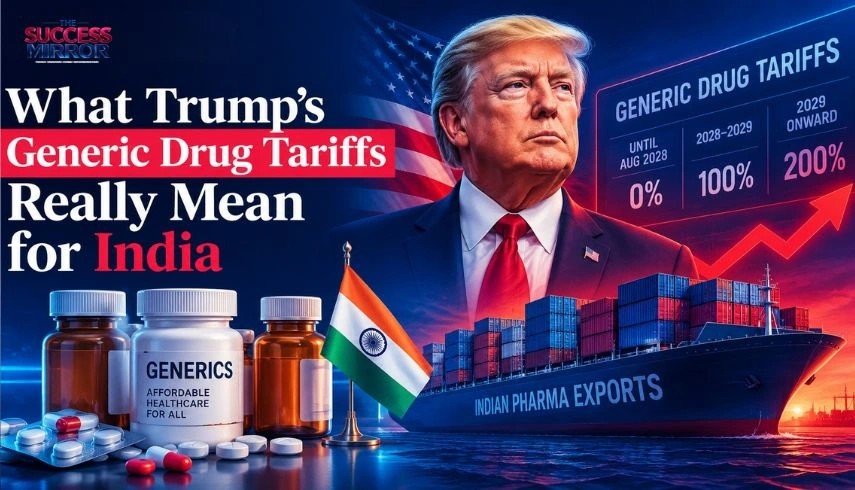
The policy, posted by Trump on Truth Social, lays out three phases for generic drugs imported into the US:
- August 1, 2026 – 2028: Zero percent tariff (essentially, no change from today)
- 2028 – 2029: Tariff rises to 100%
- 2029 onward: Tariff climbs further to 200%
Branded and patented drugs are governed separately under an existing Section 232 framework that has imposed a 100% tariff on imported pharmaceutical products since April 2025, a policy that several global giants, including Eli Lilly, Pfizer, and Novo Nordisk, have sidestepped through direct pricing agreements with Washington.
Generics, until now, had been the exempted category. That exemption now has an expiry date.
Why India Specifically Should Be Reading the Fine Print
India is not a bystander in this story; it is the protagonist. The country supplies close to 40-50% of all generic medicines consumed in the United States, and pharmaceutical exports to the US were valued at roughly $9.7 billion in 2025, according to the Global Trade Research Initiative. That single market accounts for nearly 38% of India’s total global pharma exports.
Put simply: nearly two out of every five dollars India earns from selling medicines abroad comes from one country that has just put a timer on the relationship.
The drugs in question aren’t niche. Indian generics are the backbone of everyday American healthcare, treatments for hypertension, diabetes, cancer, infectious disease, and mental health conditions, many of which are affordable specifically because Indian manufacturers can produce them at scale and at a fraction of branded-drug cost.
The Optimist’s Case, and Its Limits
Some analysts argue the market reaction was an overcorrection. Motilal Oswal Financial Services has suggested the long-term impact on Indian firms may end up limited, pointing to the sheer difficulty of replacing India’s manufacturing base within a two-year window.
That argument has real merit. Building pharmaceutical manufacturing capacity, with the regulatory approvals, quality certifications, and supply-chain depth India has spent decades developing, is not something the US can replicate at scale by 2028, whatever the tariff schedule says.
But “hard to replace” is not the same as “safe.” According to Arpit Chaturvedi, South Asia advisor at Teneo, the long-term risk to Indian drugmakers remains substantial even with the reprieve. He notes that pharmaceuticals rank among India’s largest net export earners, and that full implementation of the stated tariffs would meaningfully damage India’s trade balance.
There’s a subtler danger, too. Generic drug margins are notoriously thin; that’s the entire business model. If the tariff eventually raises costs beyond what American wholesalers are willing to absorb, some manufacturers may simply stop selling certain products in the US altogether, not because they can’t compete, but because the math no longer works.
The Real Story Is the Two Years, Not the Tariff
Here’s the angle most coverage is missing: the headline number, 200%, is not really the point. Three years is a long time in trade policy, and a great deal can change before 2029 arrives, including US administrations, court challenges, and industry lobbying.
The actual decision point is now. India has a two-year runway, not to relax, but to negotiate. Trade talks between New Delhi and Washington are already underway, and this tariff schedule hands India’s negotiators something they didn’t have before: a concrete deadline to push against.
There is precedent for this kind of resolution. Taiwan reached an agreement earlier this year that eliminated tariffs on its generic pharmaceutical exports. It’s also worth noting that Trump’s broader tariff architecture has already proven legally fragile; the US Supreme Court invalidated an earlier set of tariffs imposed under emergency economic powers legislation in February 2026, forcing the administration to pivot to a different legal basis for its trade measures. Policy built on shifting legal ground is, by definition, negotiable ground.
What Indian Pharma Should Actually Be Doing Right Now
For India’s pharmaceutical sector, boardrooms, and policymakers, the two-year window suggests three priorities:
- Push hard in trade negotiations — this deadline is leverage, not just a threat.
- Accelerate US-based manufacturing partnerships or investments where financially viable, to hedge against the worst-case tariff scenario.
- Diversify export markets beyond the US, so that no single country’s policy decision can single-handedly move the Nifty Pharma index again.
The market’s nervous reaction on July 22 wasn’t irrational; it was an early warning. The zero percent is real, but it’s borrowed time. What India’s pharmaceutical industry and government do with the next 24 months will determine whether 2028 arrives as a manageable transition or a genuine crisis for the country long known as the world’s pharmacy.